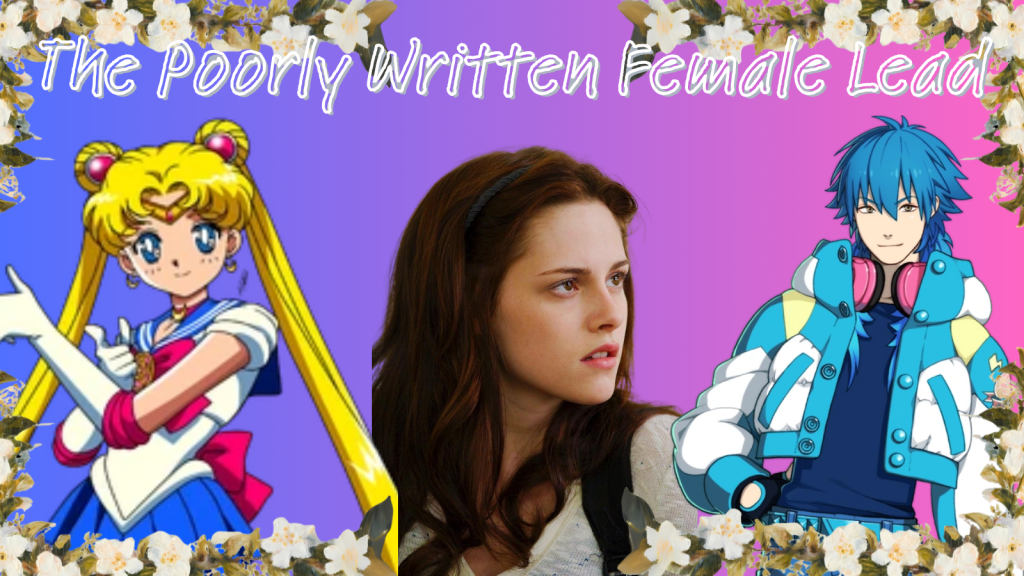
Earlier today, I saw a Reddit discussion post about poorly written female characters and the idea that disliking such a character is equivalent to misogyny. In that thread, there was also the natural backlash that male characters are not subject to the same scrutiny.
And we’ve been here before. A couple times.
Back in 2008, I picked up a little book that no one has ever heard of called “Twilight” and read all of the associates critiques that people have of it. “Twilight” as a series has its ups and downs (mostly downs from me), but back in the day I saw it as appealing to a very specific type of person that I just wasn’t. And that’s fine. Unfortunately, the little book no one has heard of sold unspeakably well and has set up a variety of trends that persist to present day, one of which is the axiom that female leads do not necessarily need to have their own characterization if they are romantic leads. In other words, if you are writing a romance book aimed at girls or women, your female lead can be poorly developed and your book will still sell.
In 2013, I started getting into visual novels. Specifically into male-on-male visual novels from a company called NitroChiral. This branched out into hunting down “otome games” or male-on-female visual novels. (I did try to find some that were female-on-female to round things out, but I found most of them to be cringey and male-gazey, which was not what I wanted in a game.) If you play a male-on-male visual novel, the male leads are fully developed characters in their own rights. They usually have their own visuals, their own goals. They are either narrating to the viewer (Dramatical Murder, Slow Damage) or they are the main character of the narrative (Togainu No Chi.) The male leads in a NitroChiral game are generally as well-developed as their love interests.
By the time we get to otome games, it’s a mixed bag. Most of the heroines of otome games are characterized by who they are to other people (Code Realize, Obey Me) and it’s hard to say that they are incredibly well-rounded outside of those relationships. Half the time, we have a vague idea of what they look like but that appearance is usually only in the character art shown during pivotal moments of the romances. At all other times, the male leads speak to the viewer. In Obey Me, you are the female lead, to the point where the player character is absent from the short anime series altogether. The female lead is such a non-entity that she can be removed from the (admittedly loose) narrative altogether.
Coming back to Twilight, criticism was leveled against Stephanie Meyer for publishing her own self-insert vampire fiction. But Bella Swan really was the every-girl of Stephanie Meyer’s readership. She had the statistically most common hair and eye color (brown and brown.) Stephanie Meyer was selling to white introverts, and so Bella was a white introvert. She was selling to readers, so Bella Swan read prolifically. Bella didn’t need to be anything more than a blank slate for people to paste their own faces onto so that they could be the object of desire between a vampire and a werewolf.
But what if the opposite was true? If Bella was this highly motivated character outside of her relationships, but Edward and/or Jacob were thin cardboard cut-outs of masculine ideals, what would that have looked like? Would that have sold as well?
In 1999, I was a child who loved Sailor Moon so goddamn much. I was bad. I was arguing with adults who definitely knew more about the series than I did in chat rooms almost every day. I had a Sailor Moon themed birthday party a full decade before such a thing was remotely feasible for the average American family and I made it work. I had a club at school that was just for Sailor Moon. I decorated little pieces of wood with marker and glitter glue, and those were our transformation scepters.
The cringe is palpable, but it really was true love.
In retrospect, one frustrating thing about the original Sailor Moon (can’t speak for the reboot; haven’t seen it) is the character of Mamoru/Darien/Tuxedo Mask. He rightfully gets made fun of quite a lot nowadays; all he did back then was provide a distraction so that Usagi/Serena could pull her head out of her ass and remember the power she used last week (bingeing magical girl anime is unkind, I think; it was a different time.) But outside of that, unless he was a hostage or a plot point, he was kind of a non-entity. He was vaguely handsome and Usagi was in love with him, and that’s kind of all he needed to be.
Did Sailor Moon suffer for that? Absolutely not, it’s one of the best selling manga series of all time and is fondly remembered to this day. But we can (and do) make fun of Bella Swan for being the same thing; she’s just vaguely pretty and Edward loves her. But you don’t see the same level of vitriol being directed at Sailor Moon or Mamoru because the love interest was poorly written.
Coming back to the trend of romance books and their poorly written female leads, I do think that Twilight set a terrible precedent by writing Bella two steps above a self-insert and then selling gangbusters. But the draw of Twilight was never Bella. You don’t play otome games for the female lead. Aside from not wanting female leads to be “weak,” we rarely quantify what exactly we do expect from our female leads.
But male leads? There are so many tropes representing our expectations for male leads that Amazon will let you filter your search results by them. Because we are reading romance books for the male leads. They are the draw to any given book and selling points. Many discussion posts talk about “book boyfriends,” or the best male leads in a romance book. They rarely discuss the female lead because she is not the focus until she is a problem for the reader’s immersion. The female lead is reduced to the set of eyes through which we see the story. We, the reader, expect her to not be poorly defined. We also don’t ask for what does define her unless we mention the man in the same breath (“Nurse and doctor,” “Knight and princess.”)
All of this is muddied by queer romances, and thank God for that. Coming back to man-on-man visual novels, how often do you see a male point-of-view character criticized in those narratives? Especially when he’s filling the same role as a female lead would in an otome game? When I mentioned having trouble finding engaging female-on-female visual novels, I mentioned that these were cringey and centered around appealing to the male gaze. Even in the games of which they are the only protagonists of note, women are not allowed to be fully realized characters. The presence of queer romances in this conversation helps us to see how this is not an issue about writing romance, but about writing women.
To come back to the original point of this post– the idea that poorly written female leads are prolific in the romance genre– I would argue that the poorly written female lead is almost the point. Immersing oneself in the character and engaging with the “book boyfriend” on a personal level is why the men are the selling point. At the same time, if audiences are demanding their female leads to be written better, there needs to be a shift to emphasize women as the protagonists of their own stories.
 Ruby White