Half of my day-job is asking questions. “What goals do you have for yourself?” “Why do you think he said that?” “How did that feel for you? Did you feel anything about it?” If I were anything other than a counselor, that might feel rude. Invasive. Maybe a little nosy. But asking questions is how I get more information to help someone solve a problem. We play Feelings Detective, working backwards to the scene of the emotional crime.
But unless you’re in an equally nosy profession (journalism springs to mind), why bother questioning things at all? Why do we want to ask questions? Is it really my business what the average stranger does for a living?
The answer is a pretty simple one: We ask because we want an answer.
In day-job mode, there are open-ended and closed-ended questions.
A closed-ended question expects one of a finite amount of responses. “What is your date of birth?” “Are you married?” “Pick how true this is on a scale of 1-7.” Closed-ended questions are only there for the sake of getting one basic piece of information. A closed-ended question does not need elaboration per se. There is one answer; what is that answer? We’re taught to not rely on these for day-to-day sessions or carrying on a conversation, since they are kind of asked-and-answered.
Open-ended questions don’t have an expectation behind them and they tend to carry the day. “What was that like for you?” “How did you respond to that?” “How did that make you feel?” Elaboration is almost necessary on an open-ended question, but some people don’t really get that right off the bat (more on that in a second.) An open-ended question will get you more information and arguably digs more at the root of a given problem.
One of my work acquaintances is what I would call a social butterfly. He’s incredibly gregarious and I, the nerdy recluse, envy that of him. I wish I could ask some things and genuinely care about the answer. It’s not that I don’t care how my coworkers and clients are doing— I do— but I have so much trouble just going up to someone and asking them for personal information unless I’m sitting on the right side of the desk.
Recently I read something that said if I wanted to really get to know a topic, I need to fall in love with it. I need to date it, I think was the wording. I need to ask it questions, then ask more and more until I was swimming in answers that, even if they’re unpalatable or uncomfortable to me, I should still love because they are (to the best of my knowledge) true.
I can’t ask something deep and personal to a person, but I can absolutely ask it of a topic.
When I research, I go old-school. And, by old school, I mean elementary.
Any time we started up on a new topic, our teacher would either give us a worksheet with this diagram or she’d make it on a large piece of paper: A set of three columns, with the headings “Know, Ask, Learn.”
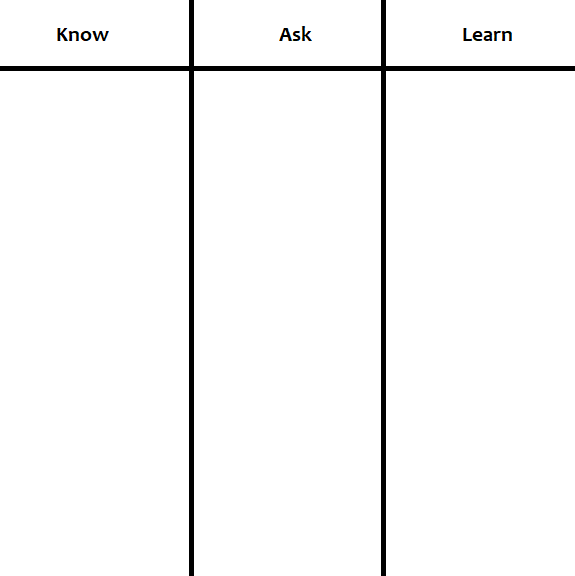
Tell me if this looks familiar, millennials.
Let’s say the topic was Victorian food, something I need to research for my upcoming fantasy book. I would fill the left-most column with things that I know about Victorian foods.
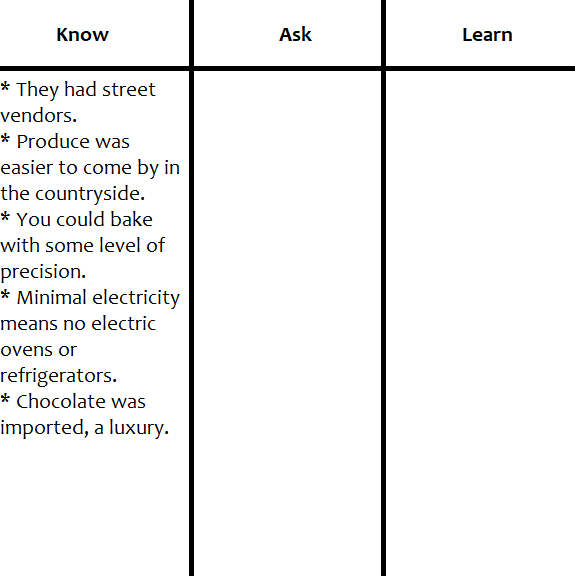
While not all of that may be true (something that I might discover incidentally during my research phase), it is the base of my knowledge on the subject for now.
Next I fill in questions…
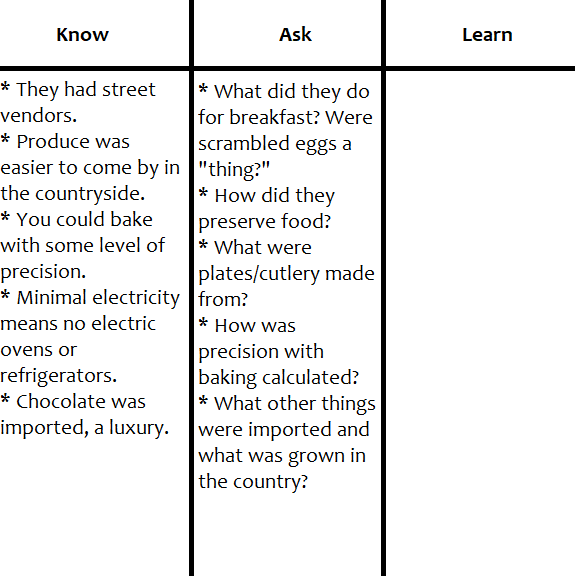
So we’ve found our questions. There’s a variety of those open- and closed-ended questions we talked about before and we’re going to get to that. Now we get to answer them. In my youth, we would hunt down books on our chosen topics and dig through them to find some kind of answer. Nowadays we have Google, but even that has to be used with caveats. I would encourage people to find the information corroborated a few times.
Here comes the fun part of open and closed questions. Regarding my first query about scrambled eggs. I could ask the closed-ended “Did the Victorians eat scrambled eggs?” and I could get my simple yes-or-no. I could get my information fast, the hookup version of dating my subject. Yes, no, my place, your place, wham-bam-thank-you-ma’am; simple stuff. Or I could ask the more involved question: What did the Victorians do for breakfast? That’s when I find articles like “What Was Breakfast Like In Victorian England?” where I get to learn about Prince Alfred’s influence on Queen Victoria’s table and the rise-and-fall of breakfast cereal.
And I got to learn that, yes, the Victorians had eggs with their breakfasts. But were they scrambled? Down another rabbithole we go with “How did Victorians take their eggs?” I also appended the word “scrambled” to the search. Minimal or irrelevant results would indicate that the Victorians didn’t scramble their eggs, but anything else might be useful.
Then, behold, the gem at the bottom of the rabbithole: The Scotch Woodcock! Consisting of a scrambled egg served over toast with anchovy paste, the dish confirms that Victorians did, in fact, eat scrambled eggs.
And repeat…
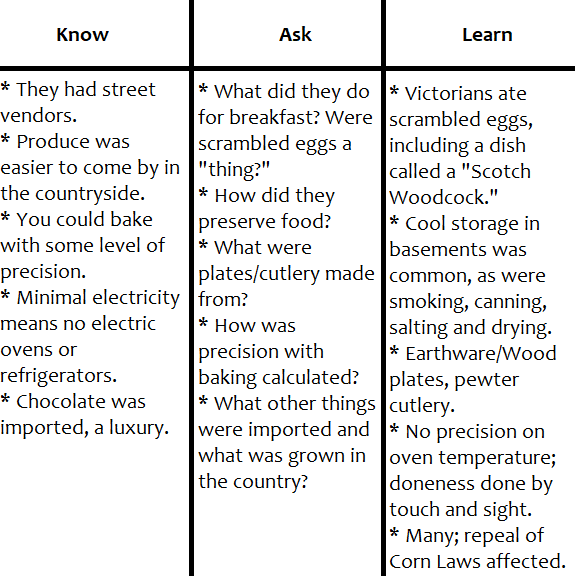
I couldn’t fit all the cool new stuff I learned onto one chart! I had to abbreivate and be super vague with the last entry because the effects of that Corn Law repeal were nuts! All because I asked the question, asked it right, and found the wealth of information I wanted.
I would encourage my fellow writers, researchers, and nosy bastards to use the Know-Ask-Learn charts. I’ve always found that they organize my thoughts well and they’re so versatile and low-barrier. One time, I got my tarot cards read and I was told to approach my work the way that an amateur would. To apply my skills with the vigor of a new-comer. To me, that is what the art of asking a question does.
 Ruby White